Know Your Ánima · Nonofanía
How to play Nonofanía
The nonograms in Know Your Ánima’s drawer, explained in 5 minutes.
Inside the drawer in your garden, twelve objects are hidden. Each one is locked inside a nonogram: a logic puzzle where you fill in squares following numbers until a picture appears. No math and no guessing needed: everything can be deduced.
1 · The basics
What is a nonogram?
A nonogram is a grid with numbers along its edges. The numbers tell you how many squares to fill in each row and each column. When every row and column matches its numbers, the filled squares form a picture: in Nonofanía, the object that was hidden.
You may know it by another name: Picross, griddler or “paint by numbers” logic puzzles. It’s the same kind of puzzle.
2 · The only rule
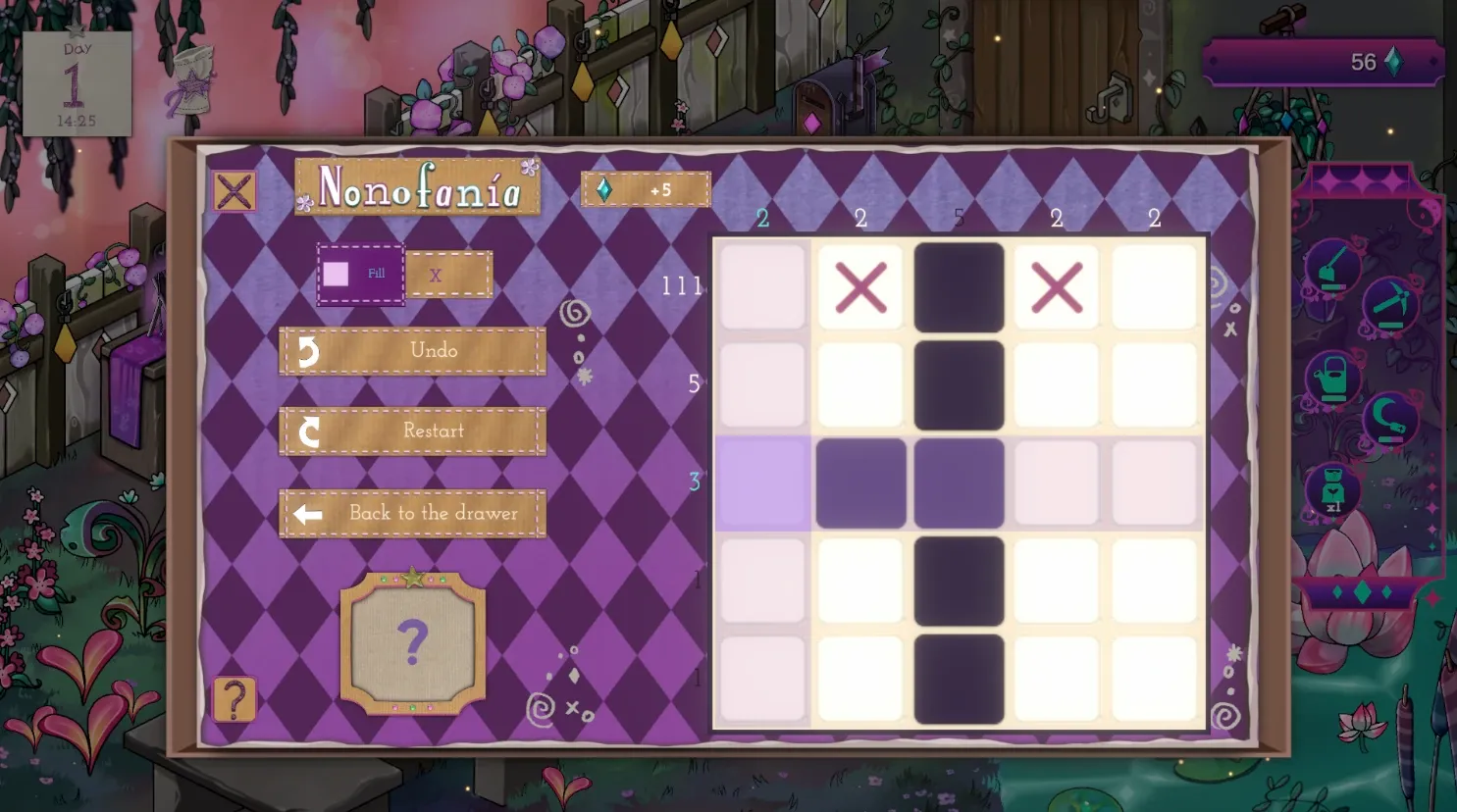
How to read the clues
- 1 Along the top are the clues for each column (read top to bottom). 2 On the left, the clues for each row (read left to right).
- Each number is a block: a group of filled squares in a row.
- –
5= one single block of 5 adjacent squares. - –
1 1 1= three blocks of 1 square, in that order.
- –
- There is always at least one empty square between two blocks. That’s why
1 1 1is never three touching squares: that would be a3. - What the numbers don’t tell you is where each block starts. That’s what you work out.
- 3 When a row or column matches its clue, its number turns dark. That’s how you know the line is done.
- 1Column clues
- 2Row clues
- 3Clue already met
3 · Step by step
Let’s solve the fork
Tap each step to watch the board fill in.
4 · The key technique
The sum trick
There’s one trick that unlocks a lot of boards: add up the blocks and the required gaps. If the total equals the length of the line, that line is already solved.
- 1
8on an 8-wide board: 8 = 8. The whole row is filled. - 2
6 1: 6 + 1 gap + 1 = 8. Only one way to fit it: six filled, one empty, one filled. - 3
4 3: 4 + 1 + 3 = 8. Another line solved without thinking twice.
And if the total doesn’t reach the length, it still helps: the leftover is how far each block can “slide”. A 6 in a row of 8 can slide 2 squares, so its 4 middle squares are filled no matter where it starts.
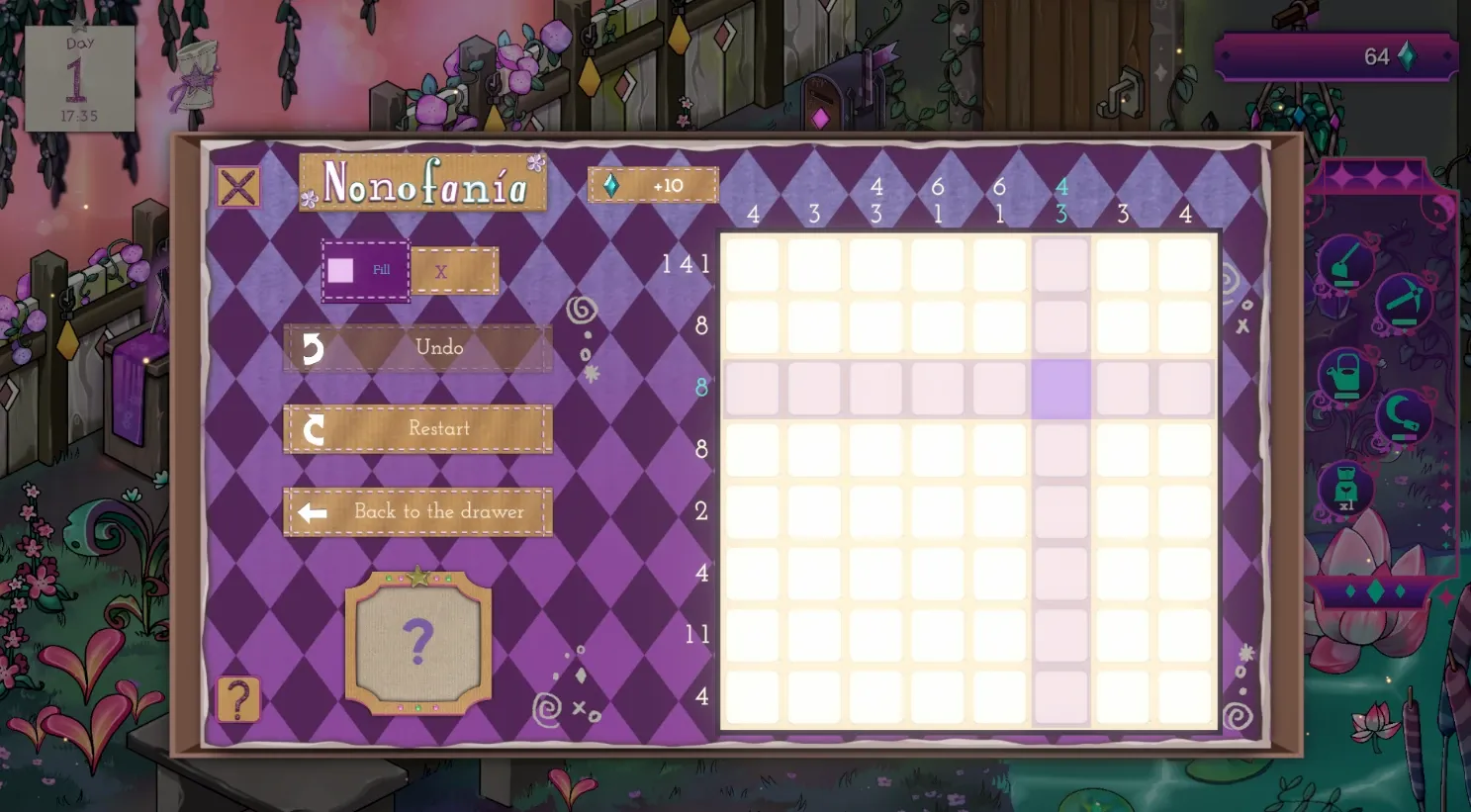
- 1The three 8 rows
- 26 1 columns
- 34 3 columns
Try it on this board: with the 8 rows and the 6 1 and 4 3 columns you already have half the picture. The rest comes from crossing rows and columns. (It’s one of the drawer’s objects: we won’t say which.)
5 · Controls
The controls
- 1Fill / X
- 2Undo
- 3Restart
- 4Back to the drawer
- 5Object frame
- 6Reward
- 7Help
Buttons
- 1Fill / X: what left click does. The X means “nothing goes here for sure”; you don’t need it to win, but it helps a lot.
- 2Undo: undoes your last stroke.
- 3Restart: clears the whole board; asks for confirmation.
- 4Back to the drawer: back to the puzzle list. Your progress is saved.
- 5Object frame: the object appears here when you solve the board.
- 6Reward: the shards you earn for solving it.
- 7
?: opens this page.
Mouse
- Left click: fills a square (or places an X, if the selector is on X).
- Right click: always places an X, no need to switch the selector.
- Drag: fills several squares in a straight line (row or column).
- Click a square of the same kind: clears it. Dragging from there clears in a line.
- On hover, the row and column light up and their clues change color, so you don’t get lost on big boards.
The garden clock keeps running while you play in the drawer. If a letter arrives, you’ll hear it; if a visitor arrives, the drawer closes on its own so you can greet them. Close it whenever you like (X or Escape): you’ll come back right where you left off.
6 · The drawer
When new nonograms arrive
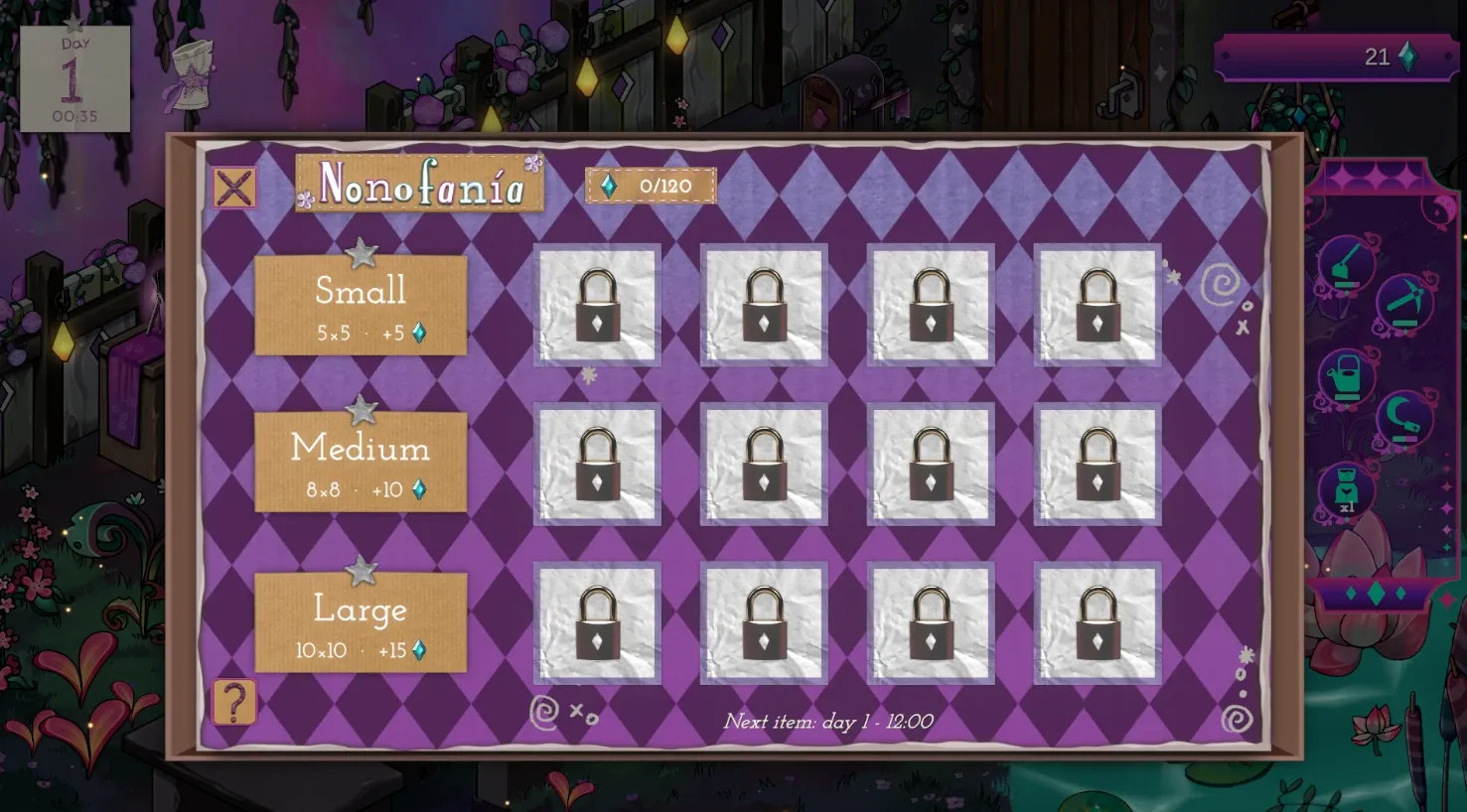
Day 1, 00:35 · all locked
- 1Sizes and rewards
- 2Shards earned
- 3Next nonogram
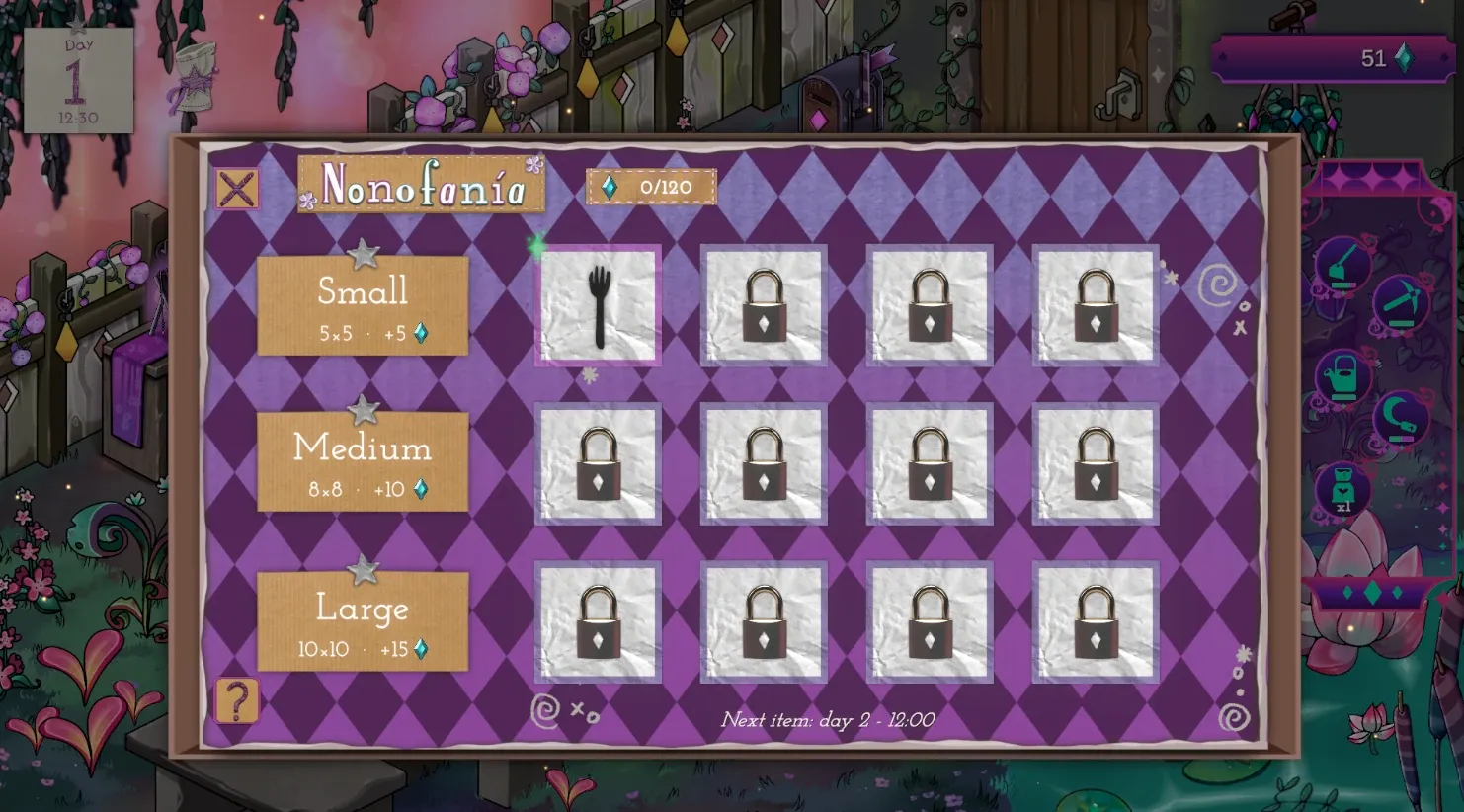
Day 1, 12:30 · the first one unlocked
- 4New nonogram
There are 12 nonograms, in three sizes 1:
| Size | Grid | Reward |
|---|---|---|
| Small | 5×5 | +5 shards |
| Medium | 8×8 | +10 shards |
| Large | 10×10 | +15 shards |
- They all start locked. Every day at 12:00 a new one unlocks, small ones first. 3 tells you when the next one arrives.
- A newly unlocked nonogram sparkles 4, and the drawer in the garden lets you know too.
- They don’t expire: skip a day and they pile up. It’s all optional.
- 2 counts how many shards you’ve earned in the drawer (120 if you solve them all).
- Every object you discover then shows up in the garden’s object box.
7 · Come back to this
Quick tips
- 1Always start with the big numbers and with lines where the sum fills everything.
- 2Use the X freely: knowing where nothing goes is half the work.
- 3When you get stuck, switch direction: what rows don’t tell you, columns usually will.
- 4Watch for clues that turn dark: that line needs nothing more.
- 5You never need to guess. If you’re torn between two options, another line holds the answer.